What is Copyediting? (And Why It’s Not the Same as Proofreading)
Most people use “copyediting” and “proofreading” interchangeably, but they’re not the same thing. People are understandably confused about what these services are—even editors don’t agree! Self-publishing, or independent publishing, has far less support and structure than traditional publishing. As a result, copyediting and proofreading services to support independent authors have evolved from the traditional processes.
Let’s talk about what each service is, when it falls in the editorial process, and how to know when your manuscript is ready for these services.
What is Copyediting
Copyediting is a stage in the editorial process designed to help prepare a manuscript for publication. The goal of copyediting is to bring a manuscript as close to error-free as possible. Copyeditors look for—and correct—errors and inconsistencies in mechanics, grammar, usage, syntax, content, spelling, punctuation, and style. Copyediting is intended to make your manuscript clear, correct, and consistent.
Clear – Copyediting rewords confusing sentences, trims unnecessary words, and flags anything that doesn’t make sense, to ensure your readers can follow the story with ease. Copyeditors will look for ease of understanding at a sentence level but also make sure that the argument or story makes sense on a large scale.
Correct – Copyediting fixes errors in spelling, grammar, punctuation, syntax, etc. It also includes light fact-checking. This is what most people think of when they think of copyediting—the classic spelling errors, repetition, or too many commas.
Consistent – Copyediting makes sure things are the same across the manuscript. Formatting, punctuation choices, capitalization rules and similar decisions often follow the rules set forth by a style guide like The Chicago Manual of Style. Fiction copyediting will also ensure consistency with characters, setting, timelines, plot, and other aspects of the story itself.
What is Proofreading
Proofreading is a careful review of the final version of a polished document. Proofreading looks for and corrects minor errors in spelling, grammar, punctuation, formatting, and consistency. This is a surface-level polish, not a rewrite for content or flow. There is a heavy focus on consistency across formatting elements, including layout, headers/footers, table of contents, headings, margins, page numbers, images, and tables.
Traditionally, proofreading happened after a document had been formatted for publication and was meant to catch any lingering errors or errors introduced by the formatting or design process. This involves comparison reading to ensure the formatted copy matches the original manuscript. These days, proofreading for independent authors often doesn’t involve comparison reading at all.
Proofreading is simply the final editorial pass—the last line of defense before the manuscript goes out into the world. Proofreading catches errors missed during copyediting or introduced during revisions or formatting. It is generally expected that a copyeditor will catch 95% of errors in a manuscript. The proofreader is another set of eyes to bring fresh attention to the manuscript one last time.
The Key Differences Between Copyediting and Proofreading
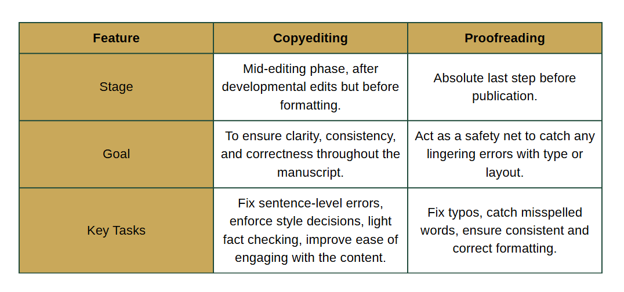
Copyediting and proofreading are not the same thing, though they are frequently confused by those new to the publishing industry. Here are some ways they differ:
Where Does Copyediting Fit in the Editorial Process? How About Proofreading?
The editorial process for an independent author is different from that of a traditionally published author. I’m planning a whole blog post on this topic, so this is just a quick overview.
Copyediting is much earlier in the process than proofreading. Copyediting happens after an author has done some self-revision, perhaps after a round of beta reading. Some authors like to hire a copyeditor before they submit to agents, though agents don’t typically require this.
Proofreading is the final stage in the process before a manuscript goes to print. It happens after copyediting and the revisions that typically follow a copyedit. Proofreading typically happens after formatting.
Do You Need a Copyeditor, a Proofreader, or Both?
Both!
This is probably not a surprise, but to set your manuscript up for success, you should hire both a copyeditor and a proofreader.
Ideally, these services should not be done by the same person.
Just as an author can be too close to their own manuscript to see the errors, an editor who has already copyedited a manuscript is less likely to catch as many errors as possible on a proofread than a proofreader who has never seen the manuscript before. A fresh set of eyes is always good.
Do you need help deciding which service your manuscript needs? I’ve created a quick reference guide to help you assess what step to take next. It’s free with sign-up below.
FAQs
Q: What is line editing? How does it play into this?
At Arden Editorial, I consider line editing to be a part of copy editing. Copy editing and line editing both adjust sentences and paragraphs for flow, readability, awkward phrasing, grammar, etc. Some manuscripts need more adjustments than others in this area. At Arden Editorial, my focus is on preserving the author’s voice, not imposing craft preferences.
Some editorial professionals offer separate line editing and copyediting services. In this model, line editing comes before copy editing and focuses more on the craft of writing, such as word choice, voice, rhythm, and style. These professionals may relegate copy editing to focusing on technical correctness, such as spelling, grammar, punctuation, and consistency per a style guide.
At Arden Editorial, I offer a detailed, line-by-line review of your manuscript that focuses on both technical accuracy and readability. I look at the writing as a whole; addressing technical aspects and craft issues within one pass. For more information, see the services page for copyediting here.
When hiring an editor, the important thing is to have a clear understanding of exactly what services they will be providing. Since what is considered line vs copy editing vs proofreading may vary, make sure you have clear language from your editor in a contract that defines what you are expecting them to do to your manuscript.
Q: Can I skip copyediting and just do proofreading?
Technically these services have very different goals. Proofreading is a much lighter service, which means the pricing is often lower. This can be attractive to independent authors, understandably so. However, a good proofreader will push back if sent a manuscript that hasn’t already been edited and reviewed (often even multiple times). A proofreader expects a manuscript to be already quite clean, so their fees are lower, as the time and effort required is lower.
If you skip copyediting and manage to find a proofreader who will accept your manuscript, be careful! Someone who offers to proofread your manuscript before it has been through copyediting is either an individual with very little actual editorial knowledge, or someone who is willing to cut corners to take your money. You cannot proofread a document that has not already been edited.
If you are struggling with the financial investment of editing, reach out and let an editor know. Many freelance editors will offer payment plans to make things more manageable. If you must skip a step, skip proofreading.
You will get the best outcome when you follow the full process.
Q: What is developmental editing?
Developmental editing is an early stage of editing which looks exclusively at the story and its elements, including characters, plot, pacing, worldbuilding, etc. This type of editing is concerned with getting a strong story, which is why it happens first. You don’t want to focus on line-level edits when the text itself is likely to go through significant changes.
If you are not completely happy with your story, this is where you should start to look for help. If you aren’t sure what you need, don’t hesitate to reach out for a consult or manuscript review.
Q: Can I just use beta readers instead of editors?
Beta readers can be great. I started in beta reading and still offer it through my Fiverr profile. Beta readers, however, do not replace editors or offer overlapping services. They do not always even offer a consistent or reliable source of feedback—as many authors quickly learn when their beta readers ghost them or never finish reading the manuscript.
Beta readers can come from many backgrounds and have various levels of ability in giving feedback. All the beta reader needs as a qualification is to be in your target audience. Most are typically unpaid and are likely someone the author knows personally.
Beta readers offer basic reader feedback. Did they like your book? Why? What did they like or not like? When did they get bored? Really helpful beta readers might give you more in-depth feedback with comments about how they felt or their reactions throughout your manuscript.
If you are paying for a beta reader, you should expect some sort of detailed write-up. That said, they are not providing you with full-scope editorial feedback in line with a developmental edit. And though a beta reader might spot a few typos or awkward wordings, they are not actively searching for them. They are reading as a reader, not as an editor.
Ready to Improve Your Manuscript?
Hi, I’m Betsy, and I’m a book editor. My company, Arden Editorial, offers copyediting and proofreading services for fantasy, science fiction, and speculative fiction. I have my copyediting certificate from UC San Diego and two years of freelance editing experience working specifically with independent authors.
If you are ready, visit the contact page to tell me about your manuscript. I love to hear about new projects and am happy to help you determine what services might meet your needs. You’ll get a free sample edit and an estimate for your project.
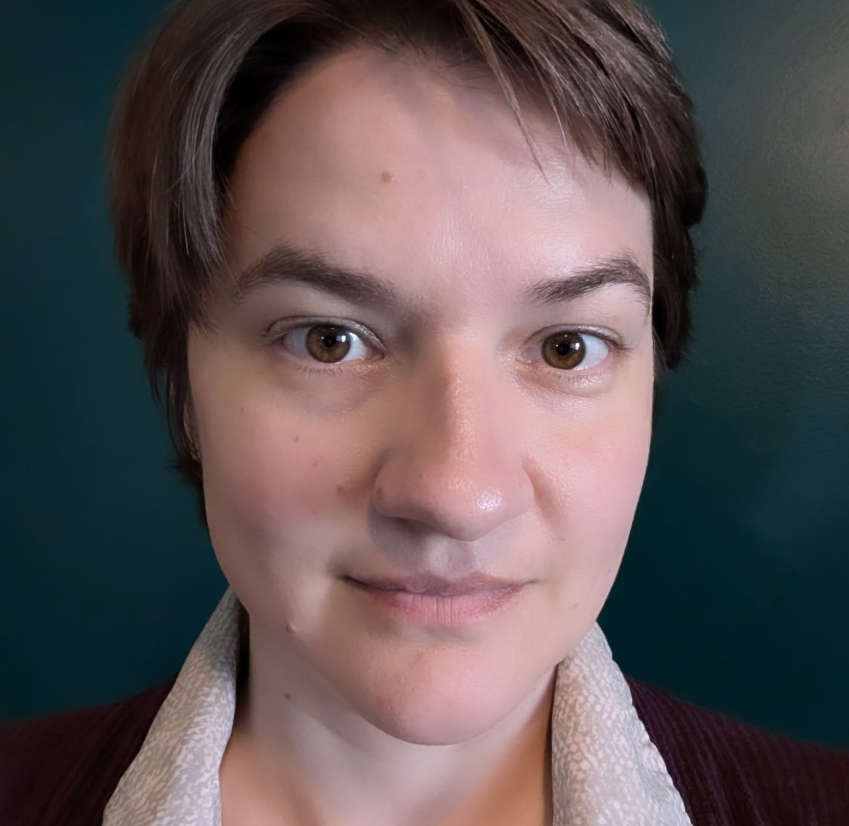
Betsy Howard is the founder of Arden Editorial, specializing in fantasy and science fiction editing for writers seeking immersive, emotionally resonant storytelling. She writes about storytelling craft, speculative fiction, and the psychology of compelling narratives.