Do I Need a Copyeditor? 7 Signs Your Manuscript Is Ready for One
One of the most common questions I get from authors is “Do I need a copyeditor? Why? How do I know when I’m ready?”
Technically, that’s three questions. I’m going to keep the answers to the first two very short, so we can really dive into the third question.
Do I need a copyeditor? Why?
Yes. Even the best authors have copyeditors. ESPECIALLY the best authors have copyeditors. Written story is an art form, and a copyeditor helps ensure it’s accessible for as many people as possible. If you want your story to stick the landing, hire a copyeditor. You’ll be surprised by the level of improvement to your manuscript.
How do I know when I’m ready for copyediting?
This is the question I really want to dive into today, as I frequently have authors reach out too early in the process, or much too late. The editorial process should happen in a very specific order, which is often news to people who aren’t familiar with the process. Often, people think editing is just one thing (or mix it up with proofreading).
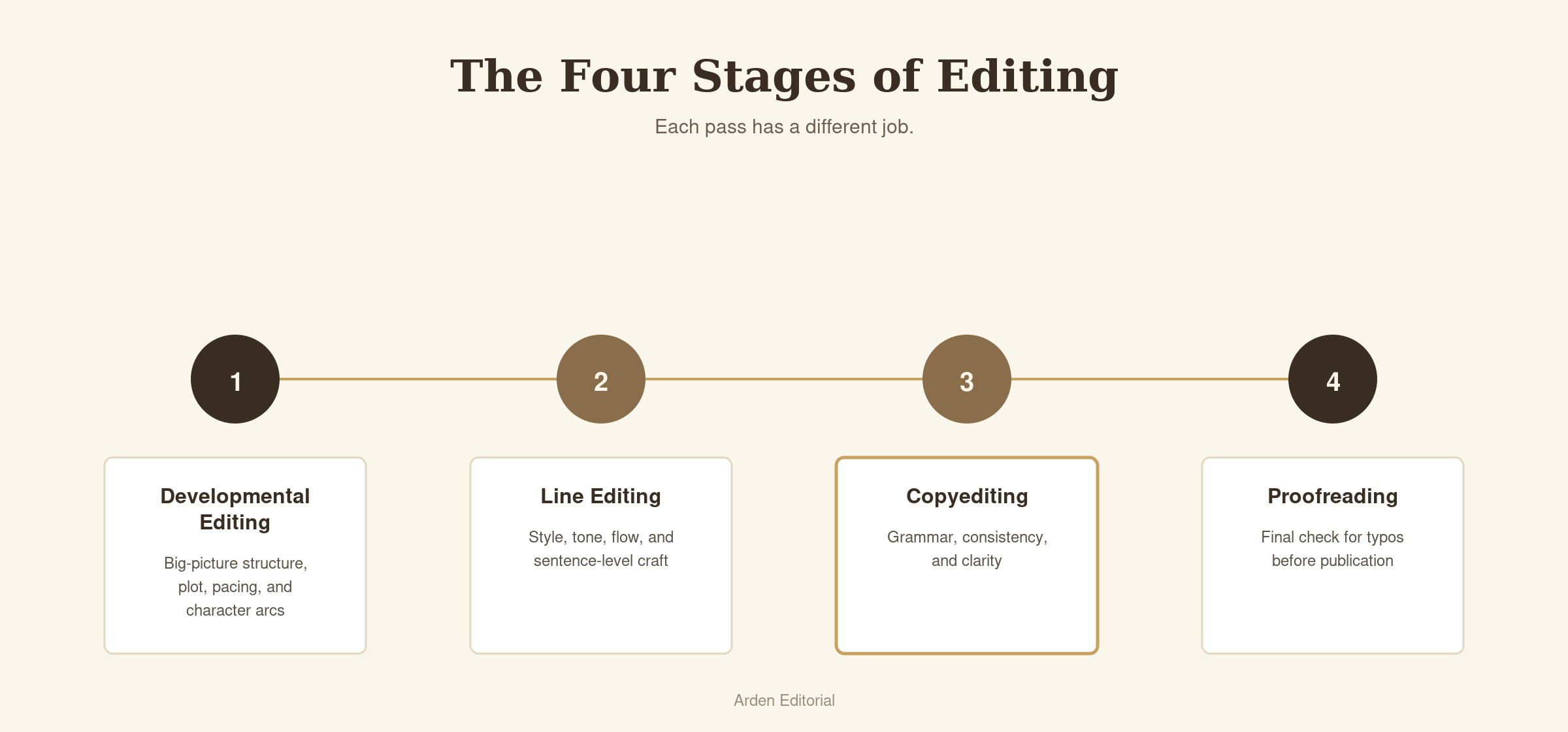
Actually, editing is four things...or maybe eight if you consider how these differ for indie versus traditionally published authors. Each of the stages of the editing process has a different job, as you can see in the graphic below.
Here are the most basic definitions:
Developmental Edit – Fix your story structure, plot, character, and pacing issues.
Line Edit – Fix your style, flow, tone, and voice issues.
Copy Edit – Fix your grammar, syntax, clarity, and consistency issues.
Proofreading – Fix your formatting and any lingering spelling or typesetting issues.
Timing is important.
Copyediting works on the line-level text, so you want to be really certain that your overall story is locked in before you give it to a copyeditor. If I copyedit your novel and then you realize an entire character arc doesn’t work, that is a lot of copyedited text you’ll be deleting. You want to catch higher level issues first, which is why authors use critique partners, beta readers, and developmental editors.
If you hire a copyeditor too late, after you’ve already queried agents or published on Amazon, you might miss your opportunity for positive first impressions. The agent might pass on your manuscript, or you might get negative early reviews due to line-level issues. Since most indie authors are only financially viable with a decent backlist, you could be hurting your chances down the road.
So, how do you know if your manuscript is ready for copyediting? Let’s get into it.
1. You’ve done at least one full round of self-editing.
Before you send your manuscript out to anyone, you should do at least one round of self-editing. If you give the manuscript at least a few days to sit, ideally a few weeks, you’ll have fresh eyes when you read through it again. You’ll be surprised by how many things you can catch on your own. Best advice for this? Read it out loud. Or have it read aloud by the feature in Word. This won’t help for big-picture issues, but dramatically improves self-editing at the line-level.
2. Beta readers have given feedback and you’ve addressed it.
After you did one (or more) rounds of self-editing, send your manuscript to a few beta readers. You want people who typically read that genre. I’ve got a whole blog post on Beta Readers, so check it out for specific advice. I started out beta reading before I went back to school for editing, and I loved it!
Beta readers will give you a mixed bag of feedback. Some will be developmental, some will be opinions, some might be line-level suggestions. Some might be useless ramblings. Some might never give you anything back at all.
When you get your feedback, read through it, let it percolate a bit, and then adjust your manuscript as you see fit. Guaranteed some of it will be useful enough that you’ll be inspired.
3. You’re confident in your story and structure but unsure about your line-level writing.
If your beta readers come back with a lot of structural concerns, underdeveloped characters, plot holes, or other high-level feedback, you’ll need to address those. There is no reason to copyedit text that might be cut or significantly changed. If you are stuck, this is the time you should call on a developmental editor. They are geniuses with story. Ask me for a recommendation, I’ve got a few good ones!
If you are done with developmental edits or your beta readers all came back and said your story was spotless and amazingly woven, you might be feeling confident in your story. At that point, authors can get stuck hyper-analyzing their prose, fixing little things here and there. This can go on for a long time if you don’t get a new set of eyes on your manuscript. It’s time to bring in a copyeditor.
4. You’ve spotted inconsistencies you can’t untangle yourself.
You’ve been in the weeds with your book for a long time. Maybe you know something isn’t lining up with your manuscript, but you can’t see how to fix it. Perhaps a beta reader pointed out a logic issue or even just a lot of variability in character descriptions, and you just don’t have the mental energy to straighten it out yourself.
No judgment. Authors work on their manuscripts for a long time, sometimes multiple years. Inconsistencies happen to every author. Sometimes you just need a fresh set of eyes. It’s time to bring in a copyeditor.
Inconsistencies are one of my favorite things to catch, because they can be so tricky. Copyeditors create a whole document for each edit, called a style sheet. The main purpose of that document is to make sure that everything is consistent. Facts about your characters or world, spelling choices, style choices, timelines, formatting, all the things.
I’ve caught changing eye colors, incorrect passage of time, variations in spelling (grey/gray anyone?), names spelled differently, personality changes, and issues with physics. Each one feels like a victory because I know I’m helping improve the novel for the author.
5. You’re preparing to query agents or self-publish.
You have a solid manuscript. You’ve self-edited and sent it to beta readers and a developmental editor. You’ve worked through all their feedback, and maybe even had another round of beta reads. The feedback is solid.
You are ready to push your baby out of the nest. Maybe you’ve decided you want to query agents and trad publish your novel. Perhaps you want to self-publish. Either way, you want to make sure that you are presenting the best possible version of your manuscript. Before you send that manuscript out into the world it needs a copyedit.
Copyediting will make sure your manuscript is clear, consistent, coherent, and correct. These are known as the four C’s of copyediting, and each of them includes a huge list of things that a copyeditor will review in your manuscript. When a copyeditor is done with your work it should be clean and accessible for its eventual audience.
If you are self-publishing, please don’t skip copyediting. When you publish your book with errors and typos your reviews will show it. People LOVE calling out errors in reviews. I’ve had multiple authors struggle with how to recover from self-publishing without copyediting. It is so much easier to do it in the right order.
A lot of agents and editors at publishing houses will say you don’t need to have your manuscript edited before querying. For some people, this is true. If you are naturally strong at the line-level and are effective at self-editing, you may be fine. Any book that gets picked up for traditional publishing will go through more rounds of editing anyways. However, there are certainly authors who are rejected by agents because of their line-level writing. If your beta readers keep telling you they struggle to get into the story, can’t stay engaged, or are distracted by mistakes, get a copyedit.
6. You’ve read it so many times you can’t see it anymore.
You’ve edited your book over and over again. You’ve made a pass for passive language, one for word choice, another for checking those dang commas. Every time you go through it, you find another set of issues you want to address. It has turned into a never-ending cycle, and you don’t know how to escape.
Or maybe you sit and stare at your manuscript, knowing it needs something, but unable to see what that is. It tells the story to the best of your ability, and you don’t know how to take it to the next level. Maybe it looks perfect to you, but your beta feedback says otherwise.
Maybe you just can’t bring yourself to look at it anymore, you’ve spent so much time on it that you might just explode if you try to edit any further.
Bringing in a set of fresh eyes will break through all these walls. I often work with authors who are relieved to have someone else take it off their hands for a while. They are happy to dive into plotting or writing their next story, knowing that their manuscript will come back to them edited and ready to go.
7. You’ve had good feedback from someone not related to you.
Someone outside of your immediate family has seen your manuscript. Scratch that—has read your manuscript. That person has given you positive feedback on your story and because of this you know that it has legs. Your manuscript has potential and readers enjoy it.
I say this with love; this person cannot be your mother. Or your father, sister, brother, grandma, uncle, or pet dog. They love you, they have to live with you, they will be biased.
So, if your critique partner said your book is worth publishing, it might be time to hire a copyeditor. If mom said it, consider getting a few beta readers first.
Takeaway
If you said yes to four or more of these, you’re probably ready for a copyedit.
Copyediting is an investment in your manuscript and your career. Copyeditors do this work for a living; they need to charge livable wages. You may need to save for a while to afford a copyedit, but it is worth the investment. You are investing in your career as an author, not just the one manuscript.
Not ready yet?
That’s okay. Better to know now than after paying for a copyedit on a manuscript that isn’t ready. Here are a few quick things to try:
Do a round of structural self-edits – Resolve plot, pacing, and organizational problems.
Get outside feedback – Beta readers or critique partners can find issues that you are too close to the manuscript to see.
Let it sit for a while – Step away from the manuscript for at least a week, ideally longer. Then reread start to finish and highlight anything that snags your attention. Fix after.
Need help?
Brand new authors might not know what they need or where they are in the process. I’m here to help! Subscribe to my email list below for a freebie Manuscript Readiness Checklist. It’ll help you assess if you are ready for a copyeditor, and what to do first if you’re not there yet.
If you aren’t sure, please reach out. I’m happy to evaluate your manuscript and give you recommendations or meet with you for a free 15-minute discovery call. You can complete my contact page and submit your manuscript. Let me know what your questions are and we’ll work through it together.
Work with Arden Editorial
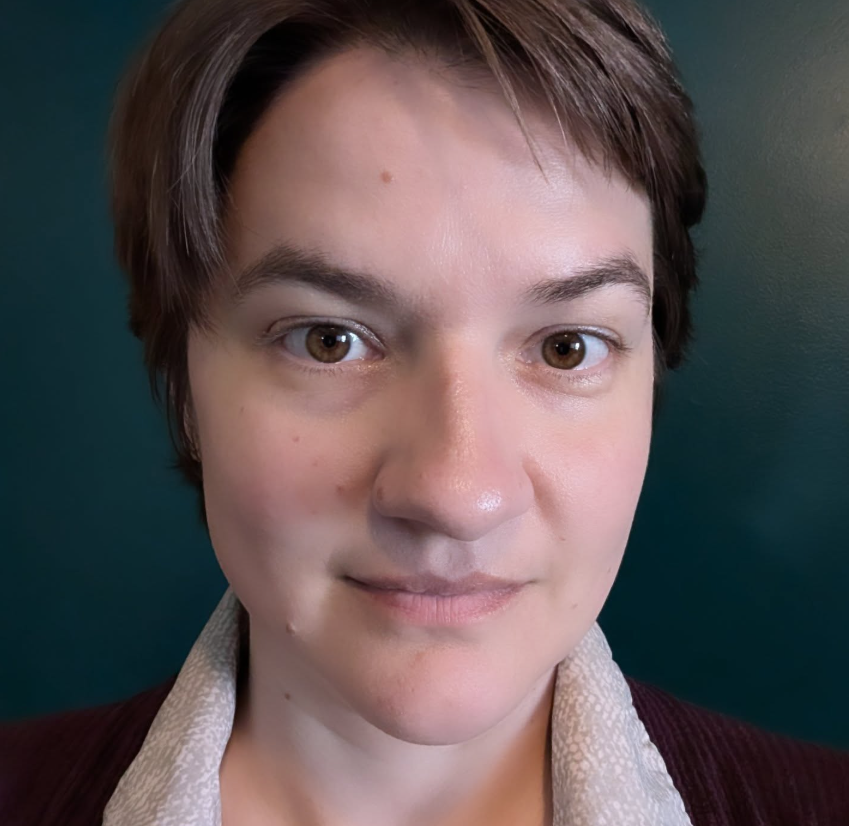
Betsy Howard is the founder of Arden Editorial, specializing in fantasy and science fiction editing for writers seeking immersive, emotionally resonant storytelling. She writes about storytelling craft, speculative fiction, and the psychology of compelling narratives.